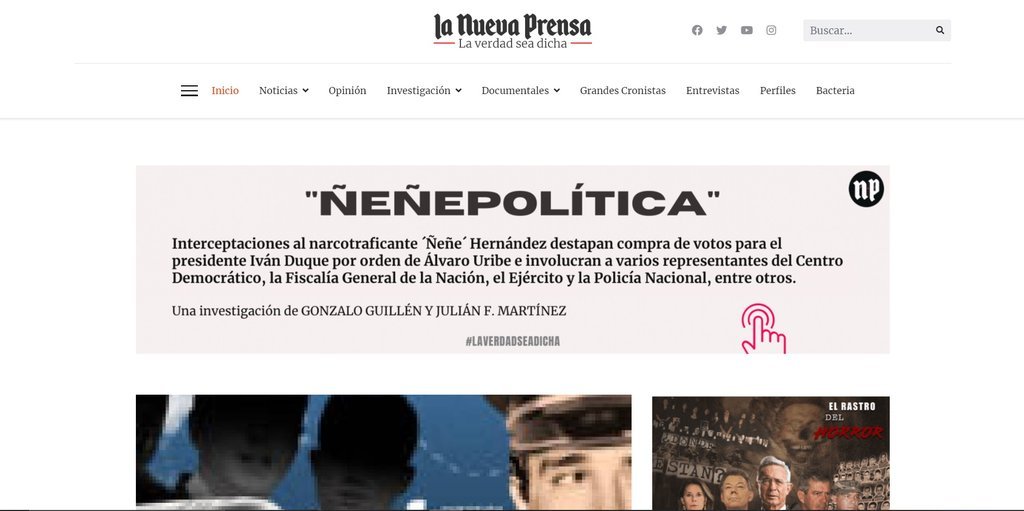
The mission of La Nueva Prensa is to keep investigative journalism alive and promote the defense of human and environmental rights, and freedom of the press and expression, as a sense of justice. Our objective is to consolidate this independent, inclusive and diverse digital communication medium, which provides citizens with timely, rigorous and truthful information, considering differential, gender and intersectional approaches in the analysis and dissemination of information. La Nueva Prensa focuses its efforts mainly on investigating the relationships of political and private power in Colombia with national and transnational criminal organizations of drug trafficking, money laundering, paramilitarism, as well as their links to crimes against humanity and other crimes. On appropriate occasions, the investigations published in La Nueva Prensa are presented to justice by their authors and their representatives. La Nueva Prensa supports the dissemination of books, series and documentaries for digital consumption on topics of memory, truth and justice, environment, racism and decolonialism, human rights and vindication of the rights of victims and survivors of the armed conflict and para-state narco-crime. Among those published by some of its journalists is the book "What did not erase the desert" by Diana López Zuleta. The documentaries "The river that was stolen. The extermination of the Wayúu nation" and "Operación Jaque. A not so masterful move", by journalist and documentary filmmaker Gonzalo Guillén. The book "ChuzaDAS. Eight years of espionage and barbarism" and the special "The trail of horror of false positives" on the digital channel Contrapoder by journalist Julián F. Martínez and the documentary series "Matarife. An unnamable genocidaire", by lawyer and writer Daniel Mendoza Leal. La Nueva Prensa has published investigations of high relevance to the public interest, among which are 'Ñeñepolitics', a series of more than 20 installments where evidence of vote buying with money from drug trafficking and criminality is exposed for the presidency of Iván Duque in the 2018 elections. Also, the revelation about the brother of the vice president of Colombia Marta Lucía Ramírez, convicted of heroin trafficking between the United States, Central America and Colombia; data that had been hidden by the vice president, despite her extensive career in public service. Investigations have also been published on the commercial and fraternal relations between pilots, known for transporting narcotics from Colombian mafias and the Sinaloa Cartel, with President Iván Duque, senior members of his government, former president Álvaro Uribe Vélez and numerous members of the Democratic Center party, even being their pilots during the last presidential and senate campaigns. In La Nueva Prensa it was also revealed that the uncle of the candidate for Colombian Ambassador to the United States (and former ambassador to that country during the presidency of Juan Manuel Santos), Juan Carlos Pinzón, was sentenced to life imprisonment for drug trafficking in that country more than two decades ago.