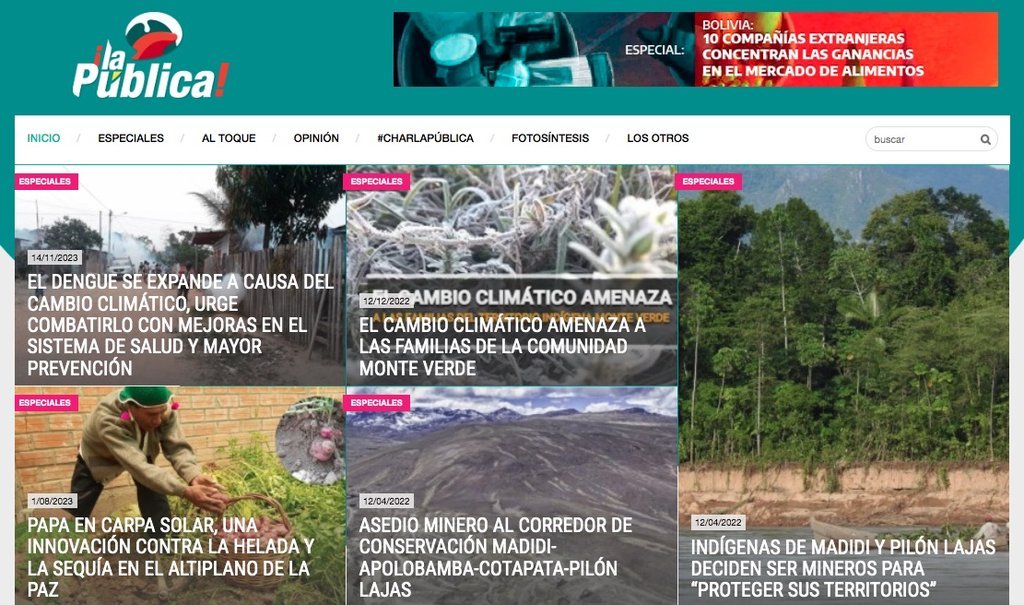
La Pública was born from a concern to build bridges between journalism and human rights activism to strengthen citizen exercise and the construction of more active and plural public spaces through technology in all its forms, indicates its website. Thus, a group of journalists interested in human rights began to connect with civil society organizations to jointly work on journalistic issues with a focus on rights, little or not covered in traditional media, and get involved in the sphere of public deliberation. Launched in 2014, "La Pública is the first national journalistic medium that adopted the community modality," they indicate on their social networks. In fact, it started with a Facebook group before a fan page. Not only did it mean a change in the distribution of content, but it was a declaration of intent of the relationship that the medium seeks with its community. The journalistic content produced by the media was shared to promote plural citizen debate, which in turn was constantly moderated by team members to control insults and eliminate people who sabotaged the dialogue between different positions. Through this channel, the audience was also consulted about topics, approaches, sources and even names of future sections. Although administrators generally shared media content, group members could share any type of news content that allowed dialogue. The group called for collective intelligence actions, virtual conversations and solidarity with human rights causes. The group was in force for almost six years. It was closed after the social crisis that Bolivia experienced at the end of 2019. "We refuse to be another space that fuels confrontation," wrote its general coordinator, Javier Badani, while explaining that it was no longer possible to monitor and moderate citizen dialogue. Despite this, La Pública maintains its essence: the agenda of topics is built with an ear glued to dialogues on social networks, more than to press conferences of authorities, and multimedia narratives. Community actions also articulated online dialogues with in-person activities, such as social and artistic interventions. Its greatest challenge is to challenge citizens to assume their responsibility in building society, indicates its website. Among them, it is worth mentioning a traveling exhibition of works by Bolivian cartoonists in tribute to Charlie Hebdó; face-to-face debates on current issues; meetings of journalists, designers and developers to carry out data journalism projects, such as #DataBO; or niche public meetings such as the one called El Público, which brought together only men to talk about masculinities at Bocaisapo, a popular and historic bar in La Paz. Likewise, in electoral times they have been part of network initiatives of citizen organizations such as Salpicón Electoral in 2015, and La Ruta de la Democracia in 2019. La Pública has shown its waist to propose online conversation spaces on current issues such as abortion, trash television, open government, among others. During the Bolivian social crisis at the end of 2019, the media called on activists to propose, moderate or participate in daily conversations from different lenses to understand the complex post-election explosion. In 2020, they launched the project "To another dog with that bone" dedicated to young audiences to address electoral issues in the face of the presidential elections that will be repeated after the one held in 2019 was annulled. This project has as its protagonists two young women who present capsules to unravel the electoral bureaucracy and moderate the cycle of conversations "Nothing will be the same", which invites us to reflect on the structural changes due to the coronavirus pandemic and public policies. The project also included face-to-face conversations in capital cities, open microphones at universities and the production of journalistic content. Another series of virtual conversations held in alliance with other NGOs is #BoliviaDebate aimed at an adult audience that seeks to reflect on the main national challenges. During the quarantine due to the pandemic, La Pública opened the microphone for a series of webinars called #ShareKnowledge where citizens shared various information such as banking online, nutrition to improve the immune system, historical analysis on how the country had faced other diseases, among others. Regarding its economic sustainability, during 2014 and 2015, La Pública received seed support from the Hivos Foundation, which allowed it to have a team of ten people in the four main cities of Bolivia: La Paz, Santa Cruz, Cochabamba and Sucre. From 2016 to the present, La Pública is sustained through the work of collaborators, funds from consultancies and projects. In mid-2019 they incorporated a new source into their business model: the digital communication service for organizations. Currently, they are in the design stage of a new business model and analysis of journalistic production models. Since 2021, journalist Miriam Telma Jemio has assumed the direction of the project in order to relaunch it by promoting actions to achieve the Sustainable Development Goals contained in the 2030 Agenda and respect for human, collective and individual rights, mainly of women and indigenous people.