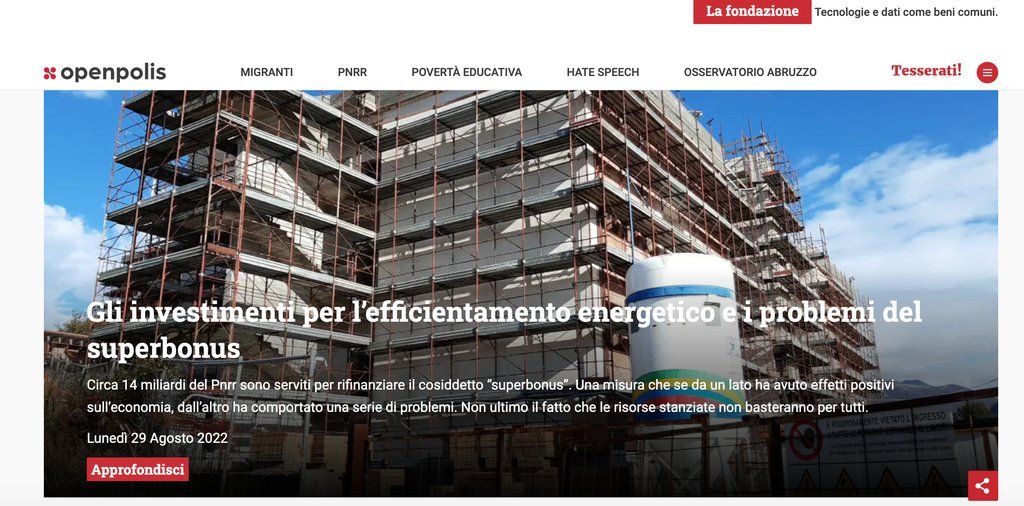
The founding principle of Openpolis is data transparency and the culture of digital commons, which drives its written production in method and approach.

Co-founder Vincenzo Smaldore does not hesitate to call himself and the other three co-founders a group of "geeks" who, in 2008, wondered how technology could foster the human ability to analyse complex phenomena and the involvement of citizens in public affairs.

Initially, they created several data dashboards, such as OpenParlamento, to increase transparency in public spending and political activities in Italy. Thanks to the increasing number of national and international grants received, over time Openpolis expanded its focus to the economy, welfare, education — in short, every public interest topic regarding Italy and its regions.

Subsequently, they increased the production of articles explaining and analysing the data collected. Openpolis' public motto is: "We tell stories with data for transparency reasons. We spread them to trigger democratic participation."

The initial team comprised four friends who committed to launching the media outlet. More than 10 years on, Openpolis employs 17 people. It is registered as a "participatory foundation" because this legal entity allows the organisation to carry out not-for-profit projects. For the same reason, it is not registered as an online media outlet.

Openpolis is not interested in developing an advertising model, and its ethical code excludes "any economic relations with public funds". In 2022, it started testing a membership programme, replicating the Guardian model: all the information is free and ad-free, and the members show that they support the project. Consistently with its founding principle, the organisation does not use data profiling.

Openpolis has won several national and international awards.

Source: Oasis Europe

Last updated date: November 2025

Location:
Rome, Italy
Year the organization started publishing:
2008
Languages:
English
Italian
Type of coverage:
National

Content

Type of content produced by theme:
Education
Environment
Politics
Technology
Economy and business
Society and human rights
Economy and finance
Gender
Feminism
LGBTIQ+
Ethnic minorities
Religious minorities
DEIA: Diversity, equity, inclusion and accessibility
Refugees
Migration
Journalism genres:
Essays
Investigative journalism
Journalism coverage types and techniques:
Data journalism
Explanatory journalism
Cross-border journalism
Collaborative journalism
Fact-checking
Tech platforms and other mediums used:
Website
Newsletter
Messaging service
Telegram
Social media platforms
Twitter
Facebook
Instagram
LinkedIn
Radio streaming
Podcast
YouTube
Vodcast or other video platforms
Primary tech platform or medium used to publish content:
Website

Audience and reach

Social media audience

Facebook number of followers:
18,927
Twitter number of followers:
12,257
Instagram number of followers:
1,735
YouTube number of followers:
182

Management and team

Founders

Female:
0
Male:
4
Founders:
Vittorio Alvino, Guglielmo Celata, Ettore Di Cesare, Vincenzo Smaldore
Directors:
Vittorio Alvino, Guglielmo Celata, Ettore Di Cesare, Vincenzo Smaldore

Team

Full-time employees:
15
Part-time employees:
2
Freelancers or consultants:
1
Volunteers:
0

Business structure and revenue sources

Organization tax status:
Non-profit
All revenue sources reported by media leaders:
Grants
Content services for others
Audience support / reader revenue
Grants from private donor organisations
Grants or investment from philanthropic organisations
Grants from Google
Grants from local and national government, and other connected governmental institutions or entities
Content development for other media
Content development for NGOs
Memberships
Individual donations
The primary source of revenue reported by media leaders:
Grants
The second most important revenue source reported:
Content services for others

Transparency

Publishes information about annual revenue
Doesn’t publish the names of donors
Has an ethics policy / manual
Publishes an ethics policy / manual
Has a data privacy policy
Publishes a data privacy policy
Doesn’t have a whistleblower policy
Has a complaints policy
Doesn’t publish a complaints policy
Has a sexual harassment or institutional violence policy
Publishes a sexual harassment or institutional violence policy
Is not signed up to a press regulator, trust initiative, or part of a press association
Publishes up to date information about its team

Why is this profile included?

This media outlet is part of our directory because it meets SembraMedia’s inclusion criteria: it produces original content, serves the public interest, and works with independence and transparency. This profile was developed using information provided directly by the media outlet, through surveys or interviews. We aim to keep the information current, but SembraMedia does not guarantee its accuracy or completeness, and recommends verifying any key details with the media organization.

In SembraMedia we use own and third party cookies for analytical purposes that allow us to track, monitor and analyze your browsing and behavior to make improvements to the product based on the analysis made, as well as own technical cookies that allow the proper functioning of the website. You can accept all cookies by clicking the "Accept" button or configure or reject their use by clicking "Reject". More information in the Privacy and Cookies Policy.